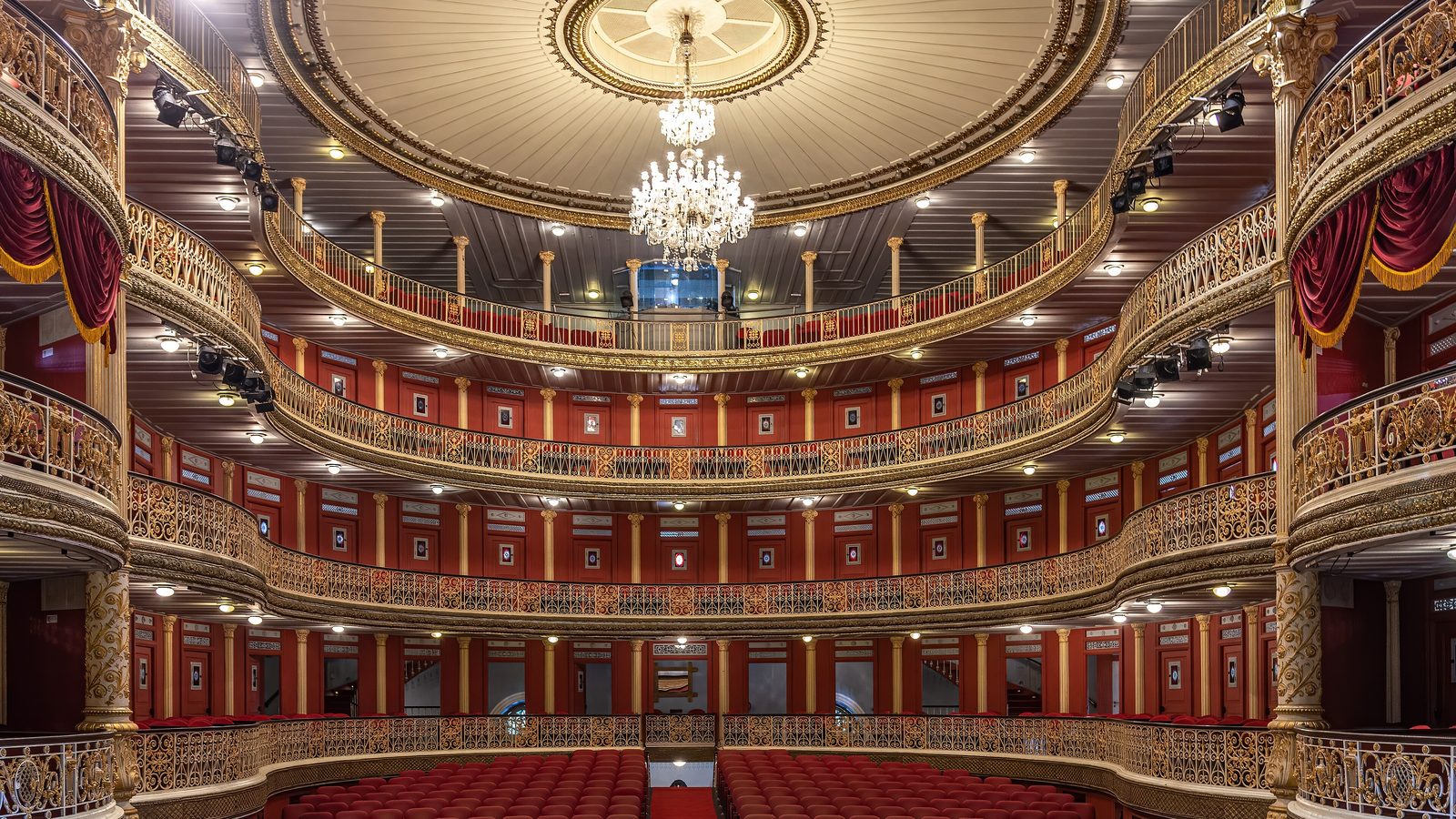
The commissioning measurement of an auditorium is made at night, in an empty room, with the ventilation off and a small crew moving quietly between positions. The room that opens the following week has eighteen hundred people in it and behaves differently. Managing the distance between those two rooms is most of what an auditorium acoustician does between practical completion and opening.
How large the difference is
An audience is the largest single absorber in a full auditorium and it is not close. A person in an upholstered seat presents something like 0.5 m² of absorption at mid frequencies; multiply by 1,800 and the audience alone is 900 sabins, which in a 17,000 m³ hall is comfortably more than every wall, floor and ceiling put together.
Which is why the seats matter so much. Absorption is conventionally quoted per square metre of seating block, and the whole art of the specification is to choose an upholstery whose empty coefficient sits close to its occupied one. Do that and the difference between a rehearsal and a performance is a few per cent. Get it wrong — thin pads on a hard shell, the cheap option, and one that saves perhaps four per cent of the seating cost — and an empty hall can measure a full second longer than the same hall occupied. An orchestra then rehearses all week in a room that lies to them about balance, arrives at the performance, and finds the hall has been replaced overnight. Every conductor has a story about this. All of them are true.
The tell is the shape of the difference as well as its size. People absorb broadband, with a mild rise through the midrange; empty upholstered seats specified properly do something similar. Empty seats specified badly are reflective in the bass and absorptive on top, so the empty hall is not merely longer, it is longer in a different way at every frequency, and the correction from one to the other is not a single number you can apply.
The measurement itself
We use a swept sine and deconvolve it — the exponential sine sweep gives a far better signal-to-noise ratio than a balloon burst or a pistol, and it separates the harmonic distortion of the loudspeaker into the negative-time part of the impulse response where it can be discarded. A calibrated omnidirectional source goes at the conductor’s position and at two or three points across the platform. Microphones go at a minimum of six audience positions chosen to include the difficult ones — under the balcony overhang, the extreme side seats, the back row — and never only the good ones, because the report will be read by people who cannot tell the difference and who will buy tickets in the bad seats anyway.
We take T30 rather than T20 where the noise floor allows it, and we record which we used, because a room with a double-sloped decay gives materially different answers to the two and quoting the more flattering one without saying so is a small dishonesty that compounds. We also record C80, the ratio of the first 80 ms of energy to everything after it, which correlates far better with what musicians and audiences actually complain about than reverberation time does. Two halls can share an RT60 and be entirely different places to listen.
Doing it occupied
Measuring an occupied hall is genuinely hard. You cannot fire a sweep at an audience. There are three routes and each gives up something.
The first is to measure during an interval with the audience in their seats, using a very short low-level sweep and asking the house to stay still for forty seconds. It works, it gives a true occupied impulse response, and it depends on a house manager willing to let you do it — perhaps one commission in five.
The second is to derive it: measure the hall empty, measure a sample of the seats in a reverberation chamber both empty and loaded with people, and compute the occupied condition from the difference. This is the standard route, it is defensible, and the uncertainty is around five per cent, which is roughly a tenth of a second in a two-second hall.
The third is to take the reverberation from the performance itself, using the decays after loud chords or the reverberant tails at the ends of movements, extracted with a Schroeder backward integration. It gives a real occupied number from the real room in real use. Its weakness is that you are at the mercy of the repertoire for the frequency content, and a programme without a single sharp cut-off gives you nothing at all.
We normally do the second and, where we are allowed, the first as well, and we publish which one produced each figure. A reverberation time is a measurement of a room in a condition, and quoting one without the condition is quoting half a result — the half that is easy to obtain, and the half that nobody was ever in the room for.