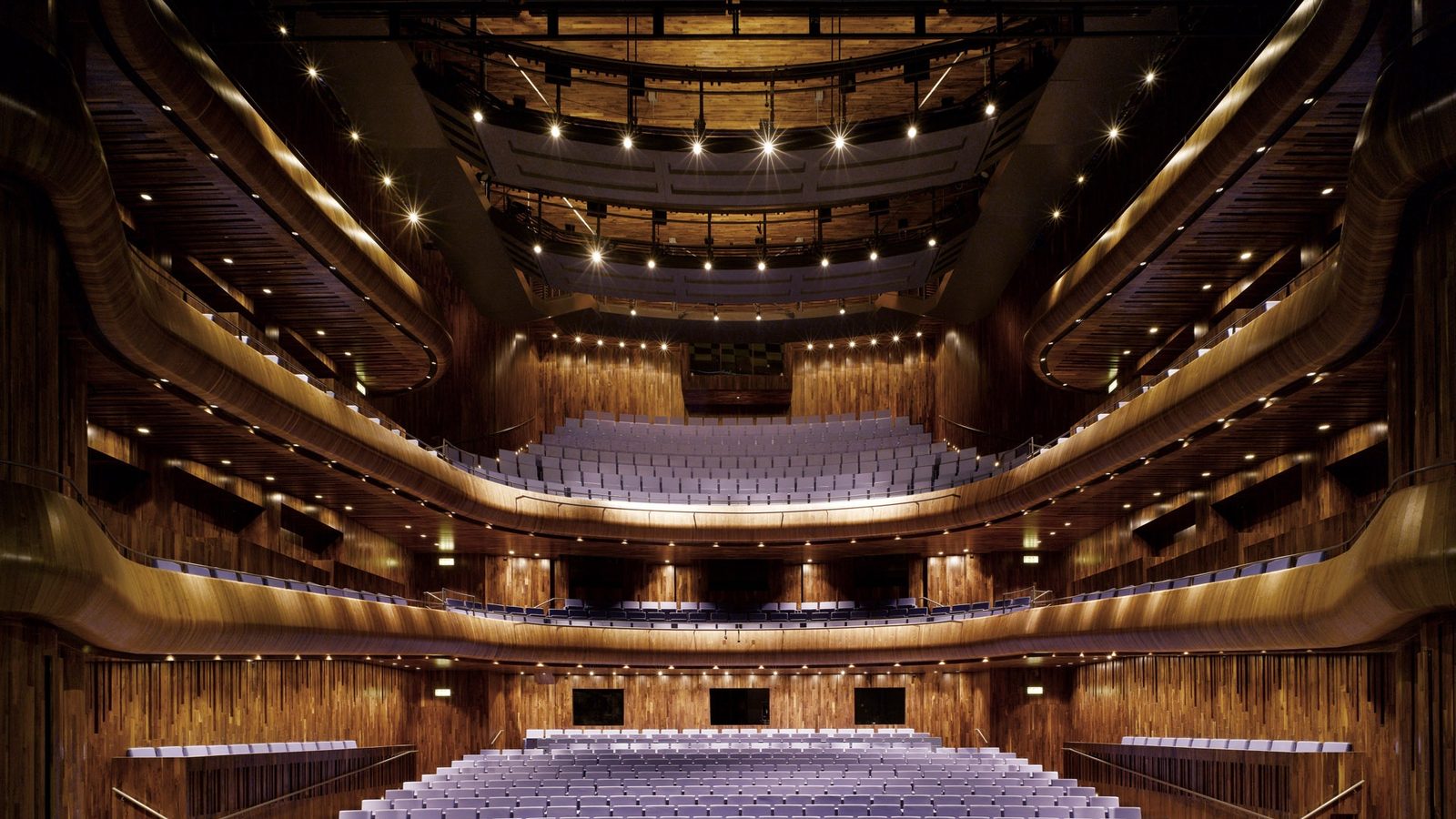
Spoken theatre wants a short room. Ropewalk is 26 m by 19 m by 11 m — 5,434 m³ for 900 seats, six cubic metres a seat — and the computed mid-frequency reverberation is 1.05 s, inside the 0.9 to 1.1 s band that a drama house is written against. A tenth of a second either side of that is audible from the back row; half a second either side is a different building. The existing shell was a rope works of 1878 with a clear span we could not have afforded to build, and the commission was really a question about how much of it to line.
The schedule that got us there is 500 m² of upholstered seating, 300 m² of gathered velour on the side and rear walls, 200 m² of 50 mm mineral wool behind stretched fabric at high level, 400 m² of timber panelling on battens, and the surviving plaster and parquet. The wool and the velour are both porous absorbers, which means both are efficient above 500 Hz and both go quiet below 250 Hz. That is the whole of the problem described in one sentence.
The 125 Hz figure computes to 1.67 s against 1.05 s at mid frequencies — a bass tail two-thirds longer than the speech range. We proposed twelve membrane traps in the void behind the upper side walls, tuned to about 90 Hz, and a change of the rear-wall lining from panelling to a deeper cavity construction. Both were priced at roughly one and a half per cent of the fit-out. Both were cut, on the reasonable ground that the company plays text and not music and that nobody in the room had ever complained about bass. Measured, the tail came in at 1.54 s: slightly better than predicted, because the timber floor and the old roof structure are doing more than the model gave them credit for, and still longer than we would like.
It matters less than we said it would and more than the client thinks. Text is fine. What suffers is the underscore — the low synthesised beds that a modern production runs under a scene — which sits in the region where the room rings and has to be mixed thinner than the sound designer wants. We put a note in the technical handbook telling incoming designers exactly where the room is long and by how much, which is a poor substitute for twelve traps but is at least honest, and costs nothing.