Project

Studio Three, Bankfoot Lane

A 621 m³ live room where Sabine and Eyring part company by a fifth of a second — and Eyring is the one telling the truth.

Mid-frequency RT60

0.48 s

Brief: Studio live room, 0.4–0.6 s

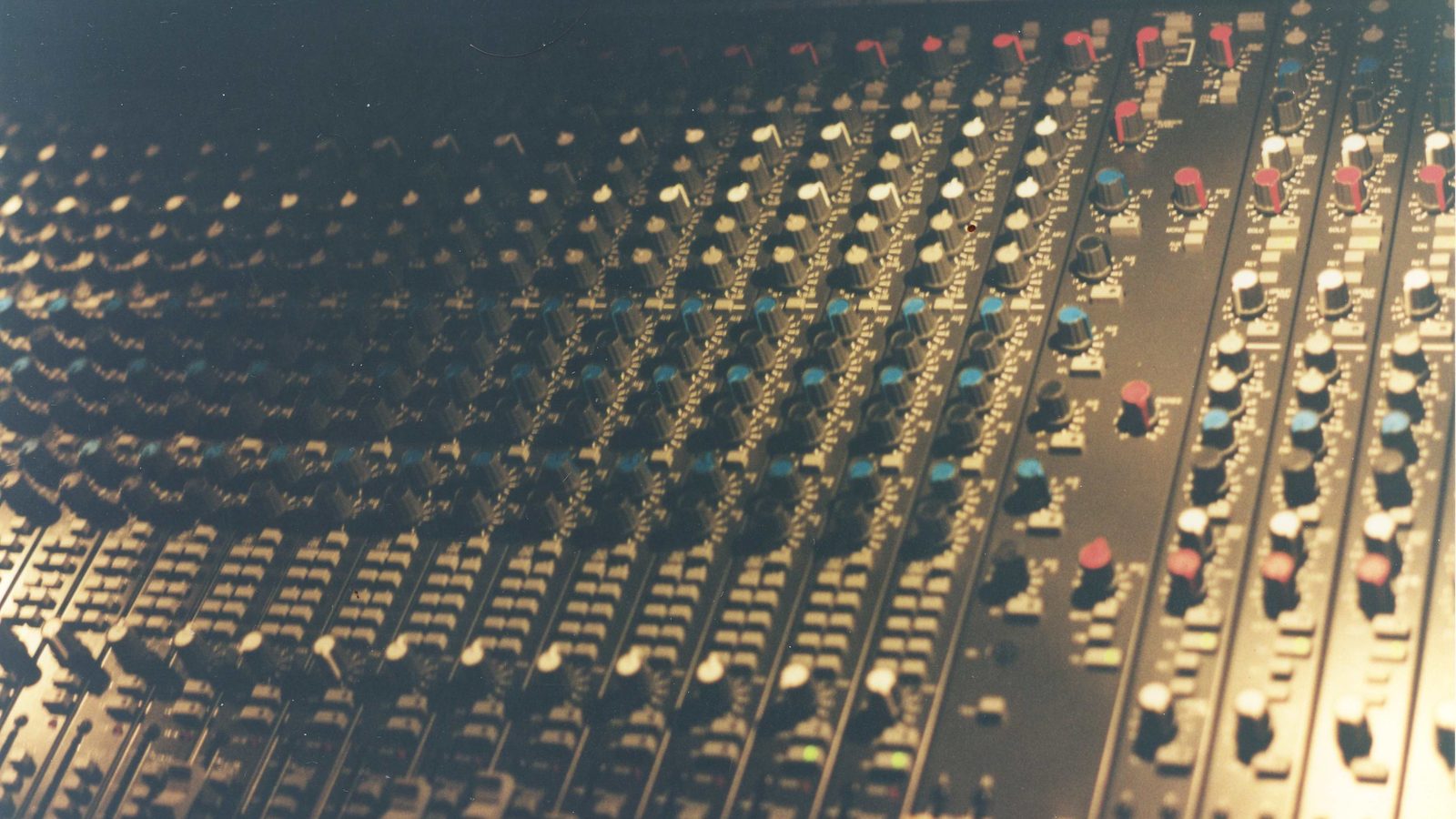
A recording studio live room with timber and fabric wall treatment
Specification

The room, as recorded.

Every figure below is an input to the arithmetic further down this page. Anything we have not measured is simply absent.

Room schedule
Volume 621 m³
Total surface area 464 m²
Length × width × height 12.5 × 9.2 × 5.4 m
Client Cormorant Recordings
Architect Pell Brooke Studio
Completed 2022
Surface schedule
Surface Area
Mineral wool, 100 mm 160.0 m²
Timber panelling on battens 90.0 m²
Timber floor on joists 115.0 m²
Plasterboard on studs 100.0 m²
Reverberation

What we predicted, and what it did.

0.48 s at mid frequencies, against a Studio live room brief of 0.4 to 0.6 seconds.

Both equations are published. Where they part company the room has become absorptive enough that Sabine's assumption of continuous decay is straining, and the lower figure is the one to believe.

Band 125 250 500 1,000 2,000 4,000
Measured, occupied 0.62 s 0.51 s 0.48 s 0.47 s 0.45 s 0.42 s
Computed — Sabine 0.69 s 0.55 s 0.54 s 0.56 s 0.56 s 0.56 s
Computed — Eyring 0.57 s 0.44 s 0.42 s 0.44 s 0.44 s 0.45 s
0.0 0.5 1.0 125 250 500 1k 2k 4k seconds Hz
Reverberation time by octave band. At mid frequencies the room measures 0.48 seconds, against a Studio live room target of 0.4 to 0.6 seconds.
Modal behaviour

Below the crossover, a room has notes.

Schroeder frequency 55.3 Hz.

Above 55.3 Hz this room behaves statistically and a reverberation time means something. Below it the room does not reverberate at all — it resonates, at the discrete frequencies listed here, and where those bunch together is where the bass will be uneven.

Axial modes, shown warm, run between one opposed pair of surfaces and carry the most energy. They are the ones anybody in the room actually hears.

Room modes below 120 Hz
Hz Order Kind
13.7 1 0 0 Axial
18.6 0 1 0 Axial
23.1 1 1 0 Tangential
27.4 2 0 0 Axial
31.8 0 0 1 Axial
33.2 2 1 0 Tangential
34.6 1 0 1 Tangential
36.8 0 1 1 Tangential
37.3 0 2 0 Axial
39.3 1 1 1 Oblique
39.7 1 2 0 Tangential
41.2 3 0 0 Axial
42.0 2 0 1 Tangential
45.2 3 1 0 Tangential
45.9 2 1 1 Oblique
46.3 2 2 0 Tangential
49.0 0 2 1 Tangential
50.9 1 2 1 Oblique
52.0 3 0 1 Tangential
54.9 4 0 0 Axial
55.2 3 1 1 Oblique
55.5 3 2 0 Tangential
55.9 0 3 0 Axial
56.1 2 2 1 Oblique

121 further modes below 120 Hz are not listed.

Take it apart

The same room, in your hands.

These are this building's own dimensions and its own surface schedule. Change a material or move a wall and the reverberation time moves with it, by the same equation we used on the drawings.

The room

38 m
21 m
17 m

The surfaces

Studio Three is a live room of 621 m³ — 12.5 m by 9.2 m by 5.4 m — built inside a 1930s light-industrial shed on a street with a bus route on it. It has no seats and no audience; it holds a string section, a drum kit, or one singer and a piano, and the brief was half a second. It is also the clearest illustration in our portfolio of why we publish two reverberation figures rather than one.

The schedule is 160 m² of 100 mm mineral wool, 90 m² of timber panelling on battens, a timber floor on joists, and the remaining walls in plasterboard on studs. Total surface area is 464 m². The absorption at 500 Hz is 186 sabins, which means the mean absorption coefficient of the room is 0.40 — four times what a plastered hall runs at. Sabine’s equation gives 0.54 s. Eyring’s gives 0.42 s. The measurement, made with the room empty and a swept sine, came in at 0.48 s, between the two and nearer Eyring.

That gap is not an error in either equation; it is the assumption underneath Sabine’s showing at the surface. His derivation treats absorption as continuous, which is true enough while the room returns most of the energy it is given and stops being true once it does not. In a room this absorptive, sound is being taken out at each reflection in visible steps, and a formula that smooths those steps predicts a longer decay than you get. We design live rooms to Eyring and quote both, because the size of the disagreement is itself a reading: if the two figures are within five per cent you have a reverberant room, and if they are twenty per cent apart you have made something quite dead and should check that you meant to.

The 100 mm wool depth was not a comfort choice. A porous absorber only does work where the air is moving, and the air is stationary at the wall and fastest a quarter of a wavelength out from it; at 250 Hz that quarter wavelength is 340 mm, which is why 50 mm of the same material would have given us 0.55 at 250 Hz instead of 0.85 and left the room boxy. Depth is the only route downward, and the client paid for 50 mm of extra depth twice over in the tracking sessions.

The bus route is dealt with by mass and by a break: a 300 mm inner leaf on isolation bearings, structurally independent of the shed, with the services routed through flexible connections and the ventilation running at 1.8 m/s in the terminal ducts. Nothing about that is visible in the reverberation figures, which is worth saying plainly, because it is the confusion this practice corrects most often. Insulating a room from a bus and treating a room for a cello are two different jobs done with two different materials for two different reasons.

Enquiries

Have you a room like this one?

A drawing, a volume, or a recording of the problem. Any of the three is enough to start, and the first conversation is not charged for.

Unit 4, Rope Walk
London SE16